Does anybody ever fact check?
Just a quick Google search shows this "Anatoli Broushkov" seems to have appeared within the last twelve hours on Google - nothing is older.
There's no journal publication being mentioned, nothing with any detail on it...
Seems a completely random thing to test the bacteria for too.
Thursday, February 12, 2009

Tuesday, January 27, 2009
Good news of the day
Blue line is 'Redundancy' and red line is 'recession'. Running just for the UK.
Ouch!
Thursday, January 15, 2009
Sprout getting Confident
Sprout Builder Pricing | Sprout
Gave the Sprout Builder a go a couple of months ago (might have been a year!). I was very impressed with its abilities, though I don't think I've got enough design experience to create anything useful.
I like seeing that they're confident enough to start charging. It will be interesting - I've seen some agencies charge as much as £20,000 for building a Widget. I'm not sure what they used to build it but the fact Sprout are now willing to create solutions directly for agencies means we may see some slightly more realistic prices for Widgets.
My own opinion is that, while free is good, quality is better. Paid for apps tend to be more usable than those that are free. The most usable (in my opinion) are the ones that are paid for by advertising since they have to bring people back to using it.
Once more agencies are using tools like Sprout (rather than just randomly building from scratch) we could see some better Widgets appear.
Gave the Sprout Builder a go a couple of months ago (might have been a year!). I was very impressed with its abilities, though I don't think I've got enough design experience to create anything useful.
I like seeing that they're confident enough to start charging. It will be interesting - I've seen some agencies charge as much as £20,000 for building a Widget. I'm not sure what they used to build it but the fact Sprout are now willing to create solutions directly for agencies means we may see some slightly more realistic prices for Widgets.
My own opinion is that, while free is good, quality is better. Paid for apps tend to be more usable than those that are free. The most usable (in my opinion) are the ones that are paid for by advertising since they have to bring people back to using it.
Once more agencies are using tools like Sprout (rather than just randomly building from scratch) we could see some better Widgets appear.
Thursday, January 08, 2009
What's True?
I'm increasingly thinking the best solution for the Israel vs Palestine problem would be a big games tournament, using an obscure board game that none of them are likely to have played.
Decided to have a read of some of the things which are happening. It's quite interesting in some ways.
Public relations
Although many of the recent wars (or probably more accurately 'sustained airstrikes') have featured some PR, this one has even more. The decisions that the military and government are taking are talked about in terms of the propaganda effect they are trying to achieve.
They are doing well in terms of keeping Hamas' rocket fire in the frame, though in some ways I'm quite impressed with their ability to keep firing despite the efforts that Israel is putting in.
An own goal though would be the IDF's YouTube channel. It reminds me hugely of one of the parts of Call of Duty IV.
IDF hitting Gazans:
Call of Duty hitting Randoms:
I honestly think this kind of video is pretty awful for their public relations as it highlights the asymmetric nature of the conflict. It's people using little Mortars against robots. They're not going to win...
Sourcing Information
The most interesting thing from this conflict is the issues with information are being brought to bear. I was watching the C4 news this evening and an IDF spokesperson was seriously questioning whether the Red Cross was actually a credible source against that of the IDF. For me it highlights the questionable nature of all the information we are receiving about the conflict.
The IDF's youtube channel disturbed me as it's all action fully removed from context. It's just people talking about how someone is a terrorist with no proof. This blog makes a good point that the IDF makes mistakes (that's not to say that the red cross never does either!).
It made me think about many of the facts going on here. We hear all the time about Hamas missiles landing on Sderot. There are some issues around facts here:
Both sides of the conflict have different views as to the veracity of the claims above. It is quite interesting as it brings a point as to what valid data is and what it could look like. This is the kind of site that is talking to us about the attacks on Israeli soil. Al Jazeera is more than happy to report on what's happening to the Palestinians.
I'm not going to go anywhere near the question of what was at Sderot before Sderot arrived.
The problem is that people have very blinkered views as to what is going on. They all throw conspiracy style theories out about what's happening in the disputed areas. Video is about the only thing that can't easily be doctored (photos are very easy to change) but video robbed of context is problematic.
Traditionally us Brits have trusted the BBC, but in recent times most articles are simply rehashes of AP information about other people's reports. Even if they were in, both sides would be accusing the BBC of bias. American networks can't be trusted but neither can the Arabic ones. It's difficult, the only ones I really believe are the Chinese Media as I don't think they care either way...
For the internet, distrust of the media is actually a good thing as it will hopefully educate people to look at more than one source when investigating what's going on. This will increase the number of pages looked at and give us poor little media planners more choice in titles to use.
Unfortunately for media owners increased cross readership with other titles means that their site do not offer a unique readership and it makes it easier for us to 'buy around them'. In turn this will reduce the total number of potential outlets for news.
Decided to have a read of some of the things which are happening. It's quite interesting in some ways.
Public relations
Although many of the recent wars (or probably more accurately 'sustained airstrikes') have featured some PR, this one has even more. The decisions that the military and government are taking are talked about in terms of the propaganda effect they are trying to achieve.
They are doing well in terms of keeping Hamas' rocket fire in the frame, though in some ways I'm quite impressed with their ability to keep firing despite the efforts that Israel is putting in.
An own goal though would be the IDF's YouTube channel. It reminds me hugely of one of the parts of Call of Duty IV.
IDF hitting Gazans:
Call of Duty hitting Randoms:
I honestly think this kind of video is pretty awful for their public relations as it highlights the asymmetric nature of the conflict. It's people using little Mortars against robots. They're not going to win...
Sourcing Information
The most interesting thing from this conflict is the issues with information are being brought to bear. I was watching the C4 news this evening and an IDF spokesperson was seriously questioning whether the Red Cross was actually a credible source against that of the IDF. For me it highlights the questionable nature of all the information we are receiving about the conflict.
The IDF's youtube channel disturbed me as it's all action fully removed from context. It's just people talking about how someone is a terrorist with no proof. This blog makes a good point that the IDF makes mistakes (that's not to say that the red cross never does either!).
It made me think about many of the facts going on here. We hear all the time about Hamas missiles landing on Sderot. There are some issues around facts here:
Is Sderot an illegal settlement?
Was Hamas firing these before the ceasefire stopped?
Both sides of the conflict have different views as to the veracity of the claims above. It is quite interesting as it brings a point as to what valid data is and what it could look like. This is the kind of site that is talking to us about the attacks on Israeli soil. Al Jazeera is more than happy to report on what's happening to the Palestinians.
I'm not going to go anywhere near the question of what was at Sderot before Sderot arrived.
The problem is that people have very blinkered views as to what is going on. They all throw conspiracy style theories out about what's happening in the disputed areas. Video is about the only thing that can't easily be doctored (photos are very easy to change) but video robbed of context is problematic.
Traditionally us Brits have trusted the BBC, but in recent times most articles are simply rehashes of AP information about other people's reports. Even if they were in, both sides would be accusing the BBC of bias. American networks can't be trusted but neither can the Arabic ones. It's difficult, the only ones I really believe are the Chinese Media as I don't think they care either way...
For the internet, distrust of the media is actually a good thing as it will hopefully educate people to look at more than one source when investigating what's going on. This will increase the number of pages looked at and give us poor little media planners more choice in titles to use.
Unfortunately for media owners increased cross readership with other titles means that their site do not offer a unique readership and it makes it easier for us to 'buy around them'. In turn this will reduce the total number of potential outlets for news.
Tuesday, December 16, 2008
Internet Explorer users warned to change browser over security fears - Times Online
Internet Explorer users warned to change browser over security fears - Times Online: "A spokesman today estimated that one in 500 internet users had been affected."
1 in 500 is stupidly high when you've got billions of people using your system. This is the kind of thing that can actually destroy people's trust in the internet.
Hope they manage to solve this quickly. If more people switch browsers, we should see these sort of problems become less frequent - someone would have to find a way to compromise firefox, IE, chrome, opera and safari (plus numerous others) in order to get to 1 in 500. If there are 600 million internet users (a stat I remember seeing recently), then we're talking about 1.2 million people being compromised. That's stupidly huge.
I hope the spokesperson was just being wrong and meant that 1 in 500 may be affected...
1 in 500 is stupidly high when you've got billions of people using your system. This is the kind of thing that can actually destroy people's trust in the internet.
Hope they manage to solve this quickly. If more people switch browsers, we should see these sort of problems become less frequent - someone would have to find a way to compromise firefox, IE, chrome, opera and safari (plus numerous others) in order to get to 1 in 500. If there are 600 million internet users (a stat I remember seeing recently), then we're talking about 1.2 million people being compromised. That's stupidly huge.
I hope the spokesperson was just being wrong and meant that 1 in 500 may be affected...
Wednesday, December 03, 2008
Me being Slow

Founders of Google looking Geekys somewhere
It's taken me a long time, but I finally got around to reading the paper Google's founders wrote when they had their search engine up and running.
I haven't seen a similar example from any other startup where their actual process of starting up is written up in so much detail. Obviously it is still quite biased as it is an academic paper which will naturally try to talk up the achievements of the authors.
Just seeing what they did though does impress me. They came up with:
- The whole concept of crawlers
- A new way of storing files on disks
- A programme that could understand web pages
- The pagerank idea (and more importantly the implementation)
- Storing the index in a flexible manner
Also interesting to see they wrote the initial crawler in Python. Been playing around with this recently and it's good to see the best in the business are using this too.
Tuesday, November 25, 2008
Pre Budget Report
Was quite pleased with the announcements yesterday. More tax on people earning stupidly large sums of money. Less VAT. Quite good really.
Only problem is that I can forsee having to make some custom changes to lots of random things in order to accomodate the changes.
Anyway. Here's a nice Wordle view of the speeches from Darling and Osborne.
Darling first:
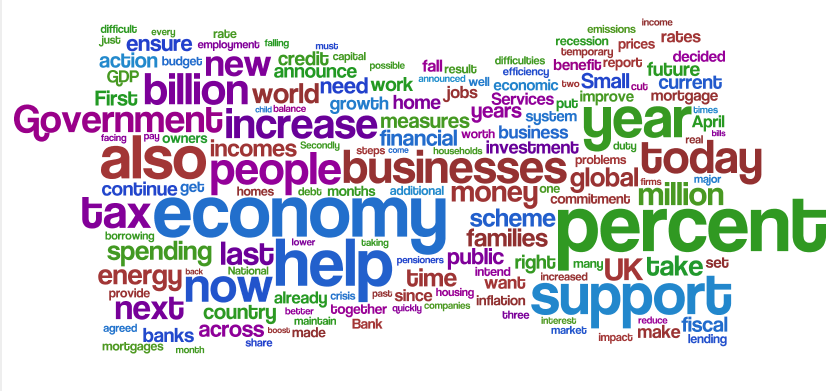
As you can see he was talking about lots of rises and changes, hence percent becomes one of his bigger words. Most interesting is the use of the words 'Government', 'help' and 'support'. Pretty much gets his meaning across.
Mr. Osborne was slightly more negative:
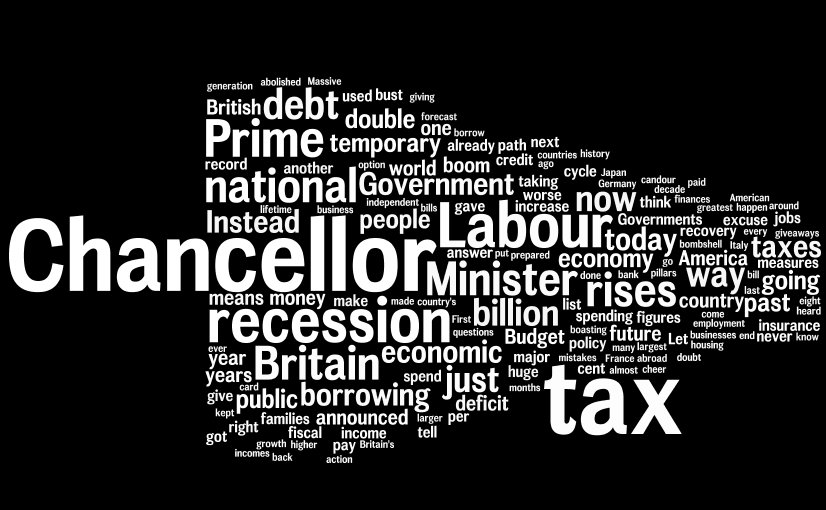
Lots of the word Chancellor, which is quite standard for the nature of the House of Commons debating style. Lots of 'recession' and 'tax' in there. ALthough the policies have changed, it still Tories talking more about tax burdens and Labour talking about funding public services.
We'll see where things go in the future, but the most telling thing back was the best day for the FTSE 100 ever. Obviously Darling can't take full credit for that, but it definitely didn't do any harm.
Only problem is that I can forsee having to make some custom changes to lots of random things in order to accomodate the changes.
Anyway. Here's a nice Wordle view of the speeches from Darling and Osborne.
Darling first:
As you can see he was talking about lots of rises and changes, hence percent becomes one of his bigger words. Most interesting is the use of the words 'Government', 'help' and 'support'. Pretty much gets his meaning across.
Mr. Osborne was slightly more negative:
Lots of the word Chancellor, which is quite standard for the nature of the House of Commons debating style. Lots of 'recession' and 'tax' in there. ALthough the policies have changed, it still Tories talking more about tax burdens and Labour talking about funding public services.
We'll see where things go in the future, but the most telling thing back was the best day for the FTSE 100 ever. Obviously Darling can't take full credit for that, but it definitely didn't do any harm.
Monday, November 17, 2008
A new Christmas
We are spending large amouts of time seeing bad news about the economy. It's still not clear if we're at a point where the economy is going to improve or if we're at a point where it's just going to continue to get worse.
The newspapers constantly serve us up news that tells us that things are going bad. The bank's own random surveys tell us that people are pessimistic about the future. Companies are laying off workers in their droves (according to reports) and hgue names are teetering on the edge of bankruptcy.
However the genuine figures I keep on seeing are not too bad at all. My clients are all going to spend more on online advertising next year. We are forecasting more internet sales. We are seeing problems from too much competition and the possibility that other people may be cutting prices more than us.
It's a confusing world. As deflation rears it's unknown head, we face an interesting world where the assumption goes from 'buy it now' to 'wait until it is cheaper'. That's not a world most marketers here have faced before. The usual immediacy message of 'SALE' is now not as effective.
We've been facing this problem with Christmas sales for the last couple of years - consumers have known that shops were going to cut prices towards the end of the season, and the shops have had to. This Christmas may see the first bucking of the trend.
Retailers have been pessimistic about their forecasts for Christmas this year. They worry that people will be stockpiling cash \ unable to lend for presents. This means they assume consumers will be spending less on Christmas. Shareholders are demanding that companies hang onto cash rather than investing it in stock. Therefore they haven't bought as much inventory as they normally do, meaning it is possible that shops will sell out.
What will happen then?
We won't see obscenely large January sales
We will see larger queues in shops
These two things will be fantastic for the retailers.
Lack of large January sales mean the retailers will hang onto more margin, making them more profitable businesses. This will in turn enhance shareholder confidence in them (something which is sorely lacking at the moment).
Larger queues in shops will be fantastic for me as it will encourage more people onto the internet. It will also be fantastic for shops as for once they will be able to recycle some urgency into their customers. There must come a point of 'sale fatigue' and I'm sure I've hit it. If I see a shop I like with a sale, I just don't bother popping in as I don't think it's siginficantly different from normal operation. I'm sure other customers are similar.
Overall a sold out Christmas (but not necessarily a good one in terms of total revenue for the shops) will improve matters on the high street. If they can't sell their inventory, expect January to be fantastic for bargain hunters, but the retailers will take a couple of years to recover.
The newspapers constantly serve us up news that tells us that things are going bad. The bank's own random surveys tell us that people are pessimistic about the future. Companies are laying off workers in their droves (according to reports) and hgue names are teetering on the edge of bankruptcy.
However the genuine figures I keep on seeing are not too bad at all. My clients are all going to spend more on online advertising next year. We are forecasting more internet sales. We are seeing problems from too much competition and the possibility that other people may be cutting prices more than us.
It's a confusing world. As deflation rears it's unknown head, we face an interesting world where the assumption goes from 'buy it now' to 'wait until it is cheaper'. That's not a world most marketers here have faced before. The usual immediacy message of 'SALE' is now not as effective.
We've been facing this problem with Christmas sales for the last couple of years - consumers have known that shops were going to cut prices towards the end of the season, and the shops have had to. This Christmas may see the first bucking of the trend.
Retailers have been pessimistic about their forecasts for Christmas this year. They worry that people will be stockpiling cash \ unable to lend for presents. This means they assume consumers will be spending less on Christmas. Shareholders are demanding that companies hang onto cash rather than investing it in stock. Therefore they haven't bought as much inventory as they normally do, meaning it is possible that shops will sell out.
What will happen then?
We won't see obscenely large January sales
We will see larger queues in shops
These two things will be fantastic for the retailers.
Lack of large January sales mean the retailers will hang onto more margin, making them more profitable businesses. This will in turn enhance shareholder confidence in them (something which is sorely lacking at the moment).
Larger queues in shops will be fantastic for me as it will encourage more people onto the internet. It will also be fantastic for shops as for once they will be able to recycle some urgency into their customers. There must come a point of 'sale fatigue' and I'm sure I've hit it. If I see a shop I like with a sale, I just don't bother popping in as I don't think it's siginficantly different from normal operation. I'm sure other customers are similar.
Overall a sold out Christmas (but not necessarily a good one in terms of total revenue for the shops) will improve matters on the high street. If they can't sell their inventory, expect January to be fantastic for bargain hunters, but the retailers will take a couple of years to recover.
Friday, October 31, 2008
New Things

I went to the Economist's Innovation Awards last night. It was held at the Science Museum, which was a fantastic venue for the awards - surrounded by random world changing inventions. They had a fondness for pointing out the world's first Telegraph machine, but there were lots of interesting props around the building.
Most award ceremonies I go to do not really award based on things that have a real impact. However this one did.
The winners also gave a little speech. Most of them, admittedly, were along the lines of 'thanks for the award but I couldn't be bothered to turn up'. One of the people who gave a proper speech was Jimmy Wales.
His point was that he didn't invent anything, he just used existing things in a new way and that's what innovation is. That's exactly what these awards were about. Thinking about it in this way, there's very few major world changing inventions that have come about in the last twenty years.
It's hard to think of any examples. The ones I would usually think of:
- Mobile Phones (more than twenty years old)
- LCD screens (more than twenty years old)
- Even the web is more than twenty years old (I'll take Mosaic as the starting point)
- Search is older than twenty years (Altavista was the start?)
- Hybrid cars are from the 70s
We're due something properly new. Hope it comes soon!
(image from Zinkwazi's photostream)
Wednesday, October 22, 2008
Burying the bad news
Home Retail warns of tougher times to come
I suspect we'll start seeing this kind of results reporting in the next couple of weeks. All the bad news companies have been burying for a while will suddenly come out with the bosses washing their hands and moaning about the current economic climate.
"Oh no, the business I bought for £900m is now worth less than half? Damn this credit crunch!"
Not my job to go through these reports but I suspect that there'll be a lot of extremely pessimistic write downs that will be miraculously turned into profits next year.
The Chief Execs who wrung their hands at the evil global markets today will then take all the credit for their cunning skills in turning their loss last year into huge profits. They'll then hit their targets and make loads of bonus money.
Good work if you can get it!
I suspect we'll start seeing this kind of results reporting in the next couple of weeks. All the bad news companies have been burying for a while will suddenly come out with the bosses washing their hands and moaning about the current economic climate.
"Oh no, the business I bought for £900m is now worth less than half? Damn this credit crunch!"
Not my job to go through these reports but I suspect that there'll be a lot of extremely pessimistic write downs that will be miraculously turned into profits next year.
The Chief Execs who wrung their hands at the evil global markets today will then take all the credit for their cunning skills in turning their loss last year into huge profits. They'll then hit their targets and make loads of bonus money.
Good work if you can get it!
Friday, September 26, 2008
Bring on the feminists!
Like the way the Londonpaper describes these women as: 'some of the most influential women in the world'.
Mrs. Brown - influential because she is married to Mr. Brown
Mrs. Palin - influential because she got picked by John McCain
Wendy Deng - influentil because she married Rupert Murdoch
Where's Merkel? Pelosi?

Mrs. Brown - influential because she is married to Mr. Brown
Mrs. Palin - influential because she got picked by John McCain
Wendy Deng - influentil because she married Rupert Murdoch
Where's Merkel? Pelosi?
Tuesday, September 23, 2008
Corporations Avoiding Tax
Was going through some old banking stuff today and found this old story:
http://www.ft.com/cms/s/0/369b723e-6a52-11dd-83e8-0000779fd18c.html
Basically it's a story from an old FT article describing how Merrill managed to cook its books in such a way as to avoid paying tax for a couple of years.
Wonder what will happen now that Merill has been bought. Does this transfer so that Bank of America doesn't have to pay tax too?
Boring question I know, but I think we should find ways to stop letting the multinationals get away with this sort of cheating...
http://www.ft.com/cms/s/0/369b723e-6a52-11dd-83e8-0000779fd18c.html
Basically it's a story from an old FT article describing how Merrill managed to cook its books in such a way as to avoid paying tax for a couple of years.
Wonder what will happen now that Merill has been bought. Does this transfer so that Bank of America doesn't have to pay tax too?
Boring question I know, but I think we should find ways to stop letting the multinationals get away with this sort of cheating...
Am loving Gapminder at the moment
I love making these charts and playing with them. Check this one out:
http://spreadsheets.google.com/pub?key=pV6F9EDiLs6CD8ofaUKM7Fg
You can really see the deaths of HBOS and B&B come to life!
Don't know
http://spreadsheets.google.com/pub?key=pV6F9EDiLs6CD8ofaUKM7Fg
You can really see the deaths of HBOS and B&B come to life!
Don't know
Sunday, September 07, 2008
The Canaries

For a long time I've accepted that the industry I work in carries a price for the interest and excitement we get from working in it. The ultimate issue is that we are the canaries of the economy. The first and easiest thing for any company to cut is their marketing budget.
While I am insulated to a significant degree by working on the internet which should remain relatively safe from the accountants, I do see a large amount of pain in the marketplace at the moment. This is particularly true for sites dedicated to brand advertising.
I was feeling guilty about the way we have been able to negotiate deals with them, driving huge discounts from the prices they usually quote. Having seen some of their ploys to get out of it (example: Telegraph), I'm not feeling so sorry.
We spend lots of time telling people not to compromise their brand for short term gain in these sorts of climate. The Telegraph sales team also tells people. They're not the only ones. We'll see more editorial integrity go down the toilet in the short term.
Looking forward to seeing the Economist's celebrity column...
Monday, September 01, 2008
Obama vs McCain
Have been playing with Google Spreadsheets. This is a look at the marketplace between McCain and Obama within the Iowa Electronic Markets. I was playing with the GapMinder button to see what we can make the data look like.
I think it looks good, I think I could make some good charts for my presentations with it, but I suspect it would have to be within the Google set of stuff rather than in a 'proper presentation'.
Sunday, August 03, 2008
New Acrobat Site

This is quite exciting. I like the fact the font is called 'Minion'. Might try and use this to send stuff to people as I don't think Adobe owns any companies that I would regard as direct competitors.
Can't see an easy way to use Styles though, and I do find that one of the things within Word that is actually well implemented. You'd have thought Adobe's record of Illustrator, Indesign and Photoshop would mean that they'd be concentrating on the whole design aspect.
Would be interested in seeing some functions that aren't in Word. However as a free alternative, can't complain too much!
I think it does succeed in looking nicer than Google's offering, but I'm pretty sure this is less easy to use. Maybe if they manage to include some way of doing a tie up with Yahoo! so that Doc files automatically come here, they might see some traction. Also needs to look at using Facebook connect so that people don't necessarily have to mess around trying to find ways to sign up to it. It's still quite easy to sign into, but I don't see it as being particularly fun. Another login added to the huge host of ones I have!
Saturday, June 21, 2008
Google Website Trends
Noticed that Google have changed their trends project to include websites.
This is a really good move as it gives us access to numbers that aren't solely based on Comscore or Hitwise's slightly suspect methodologies.
However Google haven't been entirely transparent about their own.
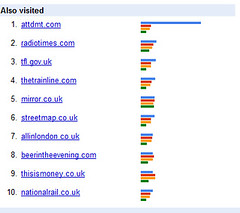
The above little bit of the graph shows the other sites that people visit from the Guardian.
The most interesting bit is that the site that's most visited is atldmt.com. This is due to iframe tags that must sit somewhere on the Guardian, serving people's ads from Atlas.
This shows some of the technology that Google is using. If they were collecting data purely from searches, they would not see this. The only way they could know that people were receiving traffic from atldmt.com would be if they were tracking where people went through some kind of tool that intercepted and monitored their webtraffic.
Now just look on your own explorer window and see if you have the google toolbar. If you have it, you've got a little friend who could be reporting all your web views back to Google central.
Google do disclose the fact that they monitor 'anonymous usage statistics'. The fact that they also track other websites that you visit means that they are keeping hold of who is who and also keeping a history of your web browsing.
This data is now easily and quickly searchable within the trends interface. It won't be long before they're offering me ways to target you through the adsense platform.
There'll be an uproar when that does happen, but I strongly suspect there's a beta test looking at how it works right now.
This is a really good move as it gives us access to numbers that aren't solely based on Comscore or Hitwise's slightly suspect methodologies.
However Google haven't been entirely transparent about their own.
The above little bit of the graph shows the other sites that people visit from the Guardian.
The most interesting bit is that the site that's most visited is atldmt.com. This is due to iframe tags that must sit somewhere on the Guardian, serving people's ads from Atlas.
This shows some of the technology that Google is using. If they were collecting data purely from searches, they would not see this. The only way they could know that people were receiving traffic from atldmt.com would be if they were tracking where people went through some kind of tool that intercepted and monitored their webtraffic.
Now just look on your own explorer window and see if you have the google toolbar. If you have it, you've got a little friend who could be reporting all your web views back to Google central.
Google do disclose the fact that they monitor 'anonymous usage statistics'. The fact that they also track other websites that you visit means that they are keeping hold of who is who and also keeping a history of your web browsing.
This data is now easily and quickly searchable within the trends interface. It won't be long before they're offering me ways to target you through the adsense platform.
There'll be an uproar when that does happen, but I strongly suspect there's a beta test looking at how it works right now.
Tuesday, June 10, 2008
Music
“When music fans can say, ‘I have all the music from 1950-2010, do you want a copy?’ — what kind of business models will be viable in such a reality?”
Nice quote from one of the founders of the piratebay.
He has a very good point though. Music is now worthless. More music exists than you could possibly listen to. Why should you buy new music?
Before we go off into "freeconomics", it should be remembered that the rights-holders have an incentive to maximise their profits. They want to preserve the status quo.
its a little like DVDs. A cheaper way to distribute films comes along, so they nark prices up. Downloading is no different.
Last-fm offers a zero cost distribution platform coupled with a zero cost Marketing platform. Problem for the record companies is that the profit will be lower due to lower revenue per recording.
My opinion is that the recording companies need to appreciate they need much lower costs in order to operate in the new Environment. Why employ salespeople to sell something that is individually worthless?
Tuesday, May 20, 2008
Google Health

Went to a presentation on Friday that included the phrase:
"The battleground will be over our data"
Google are definitely continuing the offensive. Here's Google Health. Why not trust google with the details of your various illnesses? Allow Google to know what's wrong with you and then serve you ads in relation to this.
Google say:
"Certain features of Google Health can be used in conjunction with other Google products, and those features may share information to provide a better user experience and to improve the quality of our services. For example, Google Health can help you save your doctors’ contact information into your Google Contact List."
At the moment Google place our adverts against words that are not necessarily relevant to what we are bidding against. This means that Google is using it's own information to decide that the ad is relevant. If you are an advertiser, you can see the results of this within the query report contained within adwords. There will be some words you appear against that are not remotely relevant.
We discovered this working for a previous client whereby we were appearing against competitor's keywords despite the fact we'd never entered bids against those keywords.
I suspect Google Health will allow Google to begin putting these adverts in front of people who will be searching on related terms, but will give Google a justification to put more specialised ads (with higher effective CPMs) in front of people who it knows will have an interest in the relevant drug \ product.
It's cunning, but if people don't realise what Google are doing, they will never notice. The perfect crime? We'll see.
In general, the public will happily exchange their privacy for specific benefits. This case shows a good example where the public are merrily engaged in this exchange.
Saturday, May 10, 2008
Poor Gordon

The Economist has done a particularly good cover this week. One of those times where a picture does say a good number of words!
Subscribe to:
Comments (Atom)